Reading: Cornelia Funke, Drachenreiter, 42-153/448. Listening: Die 30 schönsten Kinderlieder, Teil 1 (65 min.); Die 30 schönsten Kinderlieder, Teil 2 (64 min.); Paul Maar, Jaguar und Neinguar. Gedichte (48 min.); Gerd Köster, Die fabelhafte Welt der Tiere: Fische und Vögel, 0-49:00; Ulrich Janßen, Ulla Steuernagel, Die Kinder-Uni, "Warum lachen wir über Witze?" (0-27:00); A. A. Milne, Pu der Bär, (about 20 min.); Pinkus Tulim, Jo Raketen-Po: Ein Pupsbuch (160 min.); George R. R. Martin, Das Lied der Eisdrache (60 min.); Michael Ende, Jim Knopf und Lukas der Lokomotivführer, 0-3.53.
All of the above took place on a roadtrip, that's the reason for all the listening.
The Kinder-Uni nonfiction series is similar to the Albert E. audiobooks we have been listening to for the past two years, but it is a good bit more advanced in terms of both the language and the subject matter. It's also not quite as good in terms of the presentation. Albert E. audiobooks have a nice balance between presentation of the topical knowledge and a little story that exemplifies the material in the lives of children characters. So far (half an hour in), the Kinder-Uni is just straight-up knowledge-presentation, which is a little boring. We'll see. The topics themselves are interesting and reflective.
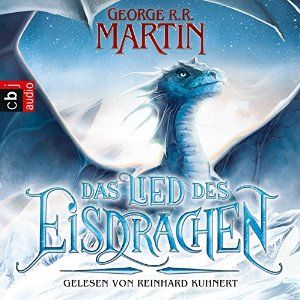
The George Martin story—wow, just brilliant. And I like that the main character is a little girl. I think J found it a little grim, and it does have a sad ending, but it's the kind of ending that stays with you.
The Tulim story is pretty funny. It's very much in the spirit of Roald Dahl in terms of valorization of lower bodily functions, the utter contemptibility of parental and authority figures, and the nastiness of spoiled children. I would say, however, that it goes on just a bit too long. The frobscottle episode in the BFG was only one episode in a complex story; here, farting does all the work. J found it funny for about an hour, then I think he started to tune out.
The Jim Knopf book is our first encounter with Michael Ende, whom I've been waiting a long time to get to. This is a wonderful, endlessly inventive story and J loves it, wanting to hear many sections several times over and interrupting to give observations and commentary.
I was a bit worried at first that the main character, being a little black boy, would be "essentialized" in a racial way, but apart (so far) from one use of the word Neger (see here for previous commentary), and the fact that black skin is associated with dirt and soot (in the figure of the locomotive driver), that has not been the case. I did pause the story at Neger—J asked what the word meant—and explain about it at some length.
The book is noted for it's coded critique of Nazism; that's in the later sections, in the dragon city, which we have not yet gotten to.
2015
Total audio: 80.33 hours
Total video: 95.26 hours
Age 6.02.31
Reading: Kathryn Lasky, Die Legende der Wächter 1. Die Entführung, loc. 88-227 (kindle edition). Listening: Roald Dahl, Charlie und die Schokoladenfabrik, 1.30 - 1:39. Viewing: Es war einmal das Leben, "Das Herz" (26 min.).
In the original Dahl book, the gluttonous boy Augustus Gloop finds himself in a situation where he may get turned into fudge.
In the German translation (published 1969), fudge is rendered as Negerküsse, "negro kisses." This term is generally avoided in German-speaking countries today (here and here), and German publishers are starting to edit this and other such terms out of children's books. This has caused an outcry in sectors of the culture. A couple of years ago, the German literary critic Dennis Scheck put on blackface (with white gloves, to boot) and went on TV to protest what he calls censorship. It was a thoroughly painful and embarrassing spectacle from an otherwise great critic.
Personally, I'm just fine with what the publishers are doing. I don't really want my child to be hearing words like this at his age, before he is really able to grasp their social resonance. I don't think this or any of the other stories in question stands or falls aesthetically with the presence or absence of such terms, which are just that—terms, not episodes or content that cannot be changed without tampering with the story as such.
However, I do think edited versions should be characterized as such, and it would also be a good idea to have a short foreward describing the edits.
As for how I dealt with the word Negerküsse in this particular case: Last time we listened to the story, about a year ago, I didn't say anything, but made a note to myself to do so the next time. Which I did. We listened to the section, then I pulled over to the side of the road and explained what the word means and why; that most people no longer use this word and should not, because it is very hurtful; that the translator used it because she was writing a long time ago, before Germans really knew or thought much about how hurtful it could be; and that the world is now a different place than it was back then.
I took the same strategy with Otfried Preußler's Die kleine Hexe (which was one of the controversial books in the German debate in 2013).
Total audio 2015: 30.43
Total video 2015: 50.23
Age 5.6.30
Listening: Ich weiß was, "Albert E. erklärt die Umwelt," 37:00-44:16 (end); Otfried Preußler, Die kleine Hexe, 59:30-1.50.
At 1.25 of Die kleine Hexe (the book chapter is called "Wollen wir wetten"), the little witch gets involved with a group of kids in the nearby town who are dressed up in costumes for Carnival/Fastnacht. This section does not come across well today, since the among the costumes are "an African," "a Chinamen," "various Orientals," and "an Indian," all hanging out with ... "a cannibal."
The first time we read the story and listened to the Hörspiel, I made no comment, but this time I paused the story and explained at some length that these kinds of costumes are mostly not—and in my view should not be—worn anymore today because people from Africa and China and Asia, as well as Native Americans, find them offensive. When the author wrote the book more than 50 years ago (1957), there were not many people from these countries living in Germany, and so the Germans didn't know them very well and didn't realize they might be insulted, but that's not the case anymore.
The illustrations in the modern edition of the book does avoid the most offensive figures:
Total audio 2015: 10:08
Total video 2015: 13:18
Age 5.3.24