Piggy pedagogy

Piggy pedagogy
Showing posts with label German history / culture. Show all posts

Saturday, April 9, 2016

Volkslieder 2


We also listened/watched to two versions of this one, a traditional interpretation by Hermann Prey and a Manhattan-Tranfer-ish one by the Ute Mann Singers. 


Since in J's piano lessons we're working on modes, I sang this one also in Phrygian, with an F natural in the penultimate bar. 

Tuesday, April 5, 2016

Kunst 5. Albrecht Dürer 3

Tonight in the Dürer comic we read about his famous woodcut of the "Four Riders of the Apocalypse."


We read on Wikipedia about what each horseman symbolizes, then I read Revelations ch. 6, where they appear, then we looked at a number of other images of the motif. 


Great for a little kid at bedtime, huh? 

Sunday, April 3, 2016

Siegfried the Dragon Slayer

This afternoon we listened to a story about Siegfried, so tonight at bedtime we discussed some images. 


It wasn't part of this particular story, but I did tell J about how that missed spot in Siegfried's back after the bath in dragon's blood turned out very badly for him. 


He was very incensed and said he hated Hagen. He also reiterated how he hates Morgana and Vivian. 

Thursday, July 16, 2015

Media today 179

Reading: Dimiter Inkiow, Die spannendsten griechischen Sagen, 67-69; Roger Hargreaves, Mister Faul. Listening: Kennst du den schon? Witze von Kindern live erzählt (41 min.); Dimiter Inkiow, Griechische Sagen I, 0-10:00.

I have done many German tongue-twisters and riddles with J, but not jokes, until the audiobook today. He greatly enjoyed them, and it seems to me he "got" about one third or so of them. I think I'm going to start doing jokes with him on a regular basis. 

This audiobook purports to be a "live" recording of schoolyard joke-telling among a group of kids. Linguistically it does make a very authentic impression, with lots of pauses and hesitations, stops and startovers, etc. The children are also sometimes quite difficult to understand (despite the excellent recording quality) because they mumble and slur. But that's how kids talk of course and it's good practice to listen to. J seemed to have few difficulties in this regard, since he already has lots of experience with normal youth speech patterns through his video-game videos and shows like Hello Benjamin! 

I myself, having begin German at age 21, never really experienced German jokes in their natural habitat. I was interested to learn that, like "knock knock" jokes in English, there are distinct genres of jokes in German. Two of them featured here are Häschenwitze ("bunny jokes") and Fritzchenwitze ("Fritzie jokes") here et al.). The former feature a juvenile bunny who repeatedly asks for carrots ("Haddu Möhren?), prompting humorous reactions and responses; and the latter center around a quick-witted and rascally little boy—Fritzchen—in interactions with authority figures, usually teachers. 

I was also very interested to learn (see link above) that the Häschenwitze first arose in East Germany as political jokes.  


Total audio 2015: 52.01 hours
Total video 2015: 74.15 hours
Age 5.9.15

Wednesday, July 1, 2015

Eulenprofessor


J: "Diese Eule kommt aus Deutschland und arbeitet an einer Eulenuniversität, wo viele Eulen Sprachen machen, und diese Eule macht Deutsch." 

Monday, June 22, 2015

Media today 159

Reading: Roger Hargreaves, Miss Vielfraß; Kathryn Lasky, Die Legende der Wächter 1. Die Entführung, loc. 2274 - 2423 (kindle edition).Listening: A. A. Milne, Pu der Bär, 3.18 - 4.18. Viewing: Rabadabading, "Meine knuffige Minecraftwelt" (39 min.) Das Leben der Verlassenen #01 (15 min); Die Sendung mit der Maus, Sachgeschichten, "Filmtricks" (29 min. x 2)

The passage in A House on Pooh Corner ch. 4 in which Pooh and Piglet discuss how "Jagulars" sit up in trees and "drop on you as you walk by" is even funnier in German than in English because "dropper" is translated "Fallenlasser," a much sillier word; J wanted to listen to this scene five times.


The Sachgeschichte about film special effects really baked the boy's noodle. We watched it together and discussed it, and he was so fascinated that I then let him watch it again right away. (I find that a second viewing—or listening, or reading—especially when it follows right after the first, is very good for language-understanding purposes, since one knows what is coming and can understand words better when the context is known. Moreover, Arnim Maiwald, the host-narrator of the Sachgeschichten ... 


... has a very mumbly way of talking that is good training to listen to and contrasts with the typical audiobook or television narrator, who artificially pronounce every. word. very. clearly.)

Also, when the arrow-through-the apple trick was demonstrated using a scene from Wilhelm Tell, J mentioned that this scene is used in the apple app he plays with alot. I was impressed; we haven't ever discussed the story before. Guess it's time to order this:


Total audio 2015: 45.54
Total video 2015: 70.53
Age 5.8.22

Saturday, June 13, 2015

Wednesday, May 27, 2015

Brandenburger Tor

I was delighted to discover that Lego makes a Brandenburg Gate kit. 


We got it as a gift over the weekend and put it together this morning.


Thursday, April 30, 2015

Media today 127

Reading: Kathryn Lasky, Die Legende der Wächter 1. Die Entführung, loc. 88-227 (kindle edition). Listening: Roald Dahl, Charlie und die Schokoladenfabrik, 1.30 - 1:39. Viewing: Es war einmal das Leben, "Das Herz" (26 min.).

In the original Dahl book, the gluttonous boy Augustus Gloop finds himself in a situation where he may get turned into fudge. 


In the German translation (published 1969), fudge is rendered as Negerküsse, "negro kisses." This term is generally avoided in German-speaking countries today (here and here), and German publishers are starting to edit this and other such terms out of children's books. This has caused an outcry in sectors of the culture. A couple of years ago, the German literary critic Dennis Scheck put on blackface (with white gloves, to boot) and went on TV to protest what he calls censorship. It was a thoroughly painful and embarrassing spectacle from an otherwise great critic.

Personally, I'm just fine with what the publishers are doing. I don't really want my child to be hearing words like this at his age, before he is really able to grasp their social resonance. I don't think this or any of the other stories in question stands or falls aesthetically with the presence or absence of such terms, which are just that—terms, not episodes or content that cannot be changed without tampering with the story as such. 

However, I do think edited versions should be characterized as such, and it would also be a good idea to have a short foreward describing the edits.

As for how I dealt with the word Negerküsse in this particular case: Last time we listened to the story, about a year ago, I didn't say anything, but made a note to myself to do so the next time. Which I did. We listened to the section, then I pulled over to the side of the road and explained what the word means and why; that most people no longer use this word and should not, because it is very hurtful; that the translator used it because she was writing a long time ago, before Germans really knew or thought much about how hurtful it could be; and that the world is now a different place than it was back then. 

I took the same strategy with Otfried Preußler's Die kleine Hexe (which was one of the controversial books in the German debate in 2013).  

Total audio 2015: 30.43
Total video 2015: 50.23
Age 5.6.30

Wednesday, March 25, 2015

Media today 99

Reading: Wieso Weshalb Warum, Wir entdecken Deutschland (skipped around); Silvia Englert, Lorenzo Orlandi, Unsere Erde, 16-17 (first plants), 32-35 (volcanos); Milena Baisch, Dorothea Ackroyd, Bildermaus-Geschichten vom kleinen Hasen, 17-24.

Viewing: Let's Play Kung Fu Panda, Episode 3 (24:17) and Episode 4 (22:00).


App: "Alice im Wunderland" by Teknowledge Software/Story Time for Kids. He went to this voluntarily during his ipad time.

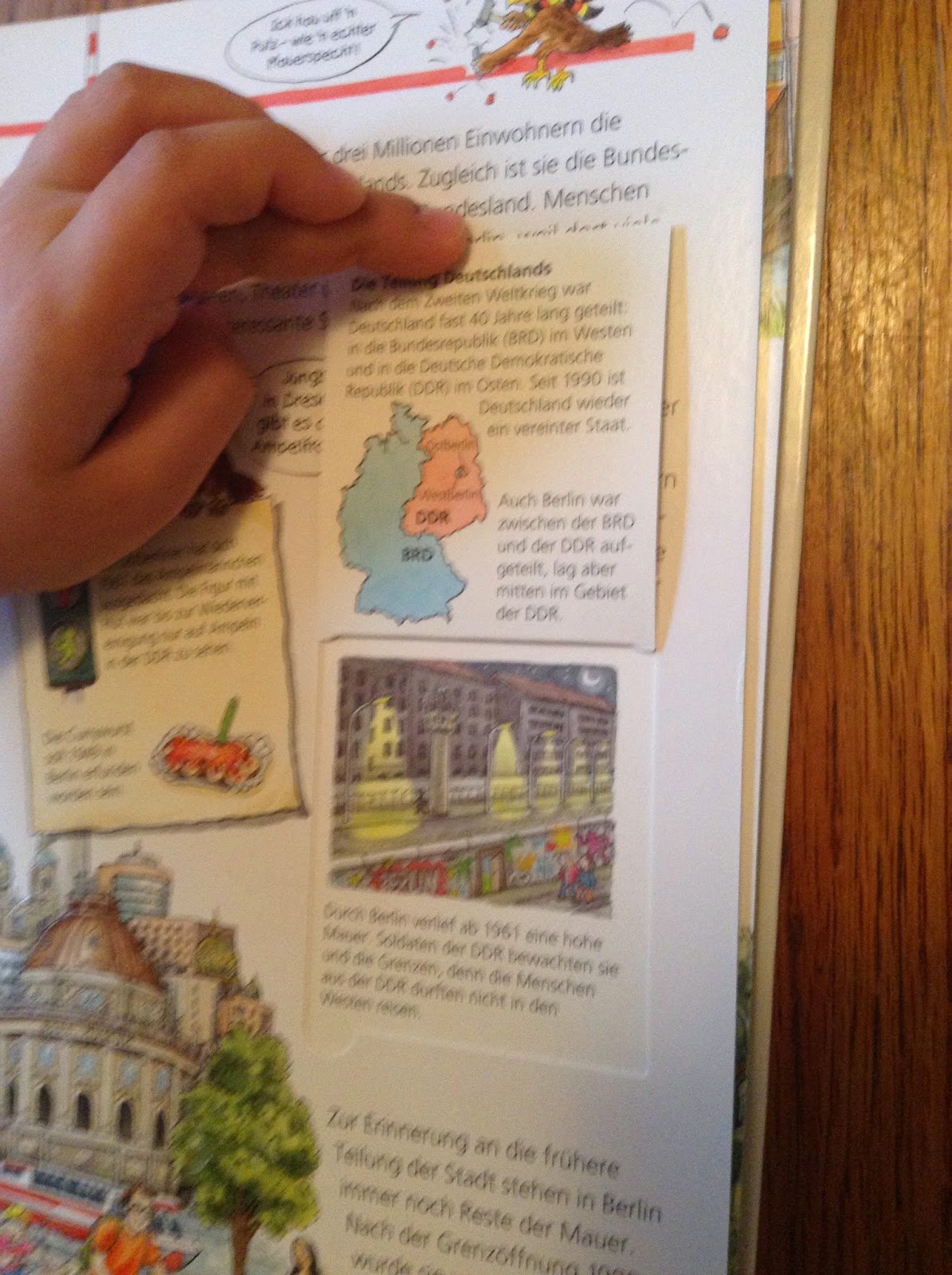
Today with the Germany book J learned about the cold war division of Germany for the first time. 


Total audio 2015: 17.42
Total video 2015: 32.40
Age 5.5.25

Tuesday, March 24, 2015

Media today 98

Reading: Christa Holtei, Astrid Vohwinkel, Damals und heute. Kinderalltag von 100 Jahren und heute; Milena Baisch, Dorothea Ackroyd, Bildermaus-Geschichten vom kleinen Hasen, 8-16.

The first book is a very interesting comparison of children's daily lives in Germany 100 years ago and today.


J found it fascinating. He's starting to ask a lot of questions and make general observations about history. In English he's currently reading Laura Ingalls Wilder's Little House on the Prarie with my wife. 

For me what is interesting about this book is that the equivalent to the present-day average middle class German family is felt to be a bürgerlich family with a live-in maid and cook, which were in fact quite privileged circumstances in late imperial Germany. The average will have been more like a working-class family. And so in certain ways this book communicates not only a sense of material progress, but also the sense that in certain ways "the German family" had it better 100 years ago. 

Ach. The nostalgia of the Bildungsbürgertum.

There are some very cool foldouts:


And also a picture of Kaiser Wilhelm in the classroom, about whom I told J a little:


The bunny story is one of those proto-readers where little images stand in for key words and phrases are repeated over and over. 


On the last couple of pages J was able to chime in with a lot of the phrases. The last several weeks of "reading words of the week" are really starting to have an impact. 

Viewing: Let's Play Kung Fu Panda, Episode 4 (22:00) and 5 (23:00)

Total audio 2015: 17.42
Total video 2015: 31.52
Age 5.5.24

Saturday, February 28, 2015

Media today 83

Reading: Nina Weger, Die sagenhafte Saubande. Kommando Känguru, 203-222 (end).

Listening:  Ich weiß was, Albert E. erklärt Taschengeld: Umgang mit Geld, 16:30-36:30

Viewing: Let's Play Kung Fu Panda, Episode 2 (20:00) and 3 (24:17) 

In the money audiobook there is a scene (min. 22), very similar to the one in the Inkiow book from a couple week ago, where the children wonder why enough money can't be created to give everybody enough, whereupon a grandfather character explains to them about inflation, specifically the hyperinflation in Germany after WW1. 

This really brings home why the Germans are so deathly afraid of loose monetary policy. They get it very young! Let's just hope German inflexibility in this regard doesn't destroy the Euro.

At 31:00 there is a scene where the sister charges her brother interest (one gumdrop) on a loan of sixty cents. When the father learns of this, he is quite unhappy, and the sister drops the interest. The ensuing section is by no means simple-minded and condemnatory of interest. Still, I find it interesting that interest is introduced into the story as something negative in itself (it's not like the father thinks, for example, the sister has charged too much interest).

Total audio 2015: 15.57
Total video 2015: 24.13
Age 5.4.23

Sunday, February 8, 2015

Literary-critical Sunday school, part 10

Reading: The Beginner's Bible, 146-163; Monika Tworuschka, Udo Tworuschka, Guido Wandrey, Die Weltreligionen Kindern erklärt, loc. 1-97/2119.

Listening: Karlheinz Koinegg, Moses und die Wüste der Wunder, 1.39-2.45 (end).


J had an interesting reaction to something in the book on world religions. 


When I read the section where the Jewish girl Ruth is explaining how Jews believe that Jesus is a Jewish man, not the son of God or the messiah, his brow wrinkled and he said that he "didn't like that." When I asked him what exactly he didn't like, he said that he didn't like the way she said what she said, not what she said. 

At least I think this is what he was getting at; I deliberately refrain from ever pressing him about his thoughts on religious questions or giving him the impression that there is a right way a priori to think about these things. By way of follow-up, I told him that we always have to keep in mind that the Jesus stories we have been reading from the bible were written by Christians, not Jews; that Christians generally think Jews were wrong about Jesus, and so the stories often make a lot of the Jews look bad, sometimes even without trying to make them look bad; but that the Jews, too, think the Christians are wrong. People of different religions disagree about a lot of stuff, and that's ok, they just have to learn to get along. 

***
   
After this, I also broached the subject of the shoah for the first time. A couple of weeks ago (in connection with the movie Bedknobs and Broomsticks), I had begun telling J about the Germans' role in the second world war. Today I told him that during that war, Germans persecuted the Jews; that many fled, but very many were killed; that after that, not many Jews have wanted to live in Germany; that many came to America and many went to Israel, which is where most of the bible stories take place and which many Jews still think of as their homeland.

J didn't evince much of a reaction, either to this or to the WW2 discussion. In connection to the latter he did say, "But the Germans are good now, right, daddy?" Which I confirmed. 

On a related note. Who knows if J will continue to progress in the German language at the current rate as he grows up. But if he does, he will essentially be a native speaker, but without any of the usual identity-conditioning factors like family and heritage (very important for traditional notions of German identity). I'm very curious to see—if it happens—what this German-American "third space" identity-hybrid will end up looking like. Obviously I will have a huge role in the process, which is quite a responsibility but very exciting as well. 

***

The conclusion to the Moses story moves into theologically pretty interesting territory. After the Israelites make and worship the golden calf, Joshua wants to execute the perpetrators. God himself tells Moses that he feels similarly, that he has decided to wipe his entire people out, except Moses, and give the latter "a brand new people that will be good and wise and hardworking and obedient, not rebellious and lazy like the Hebrews." 

Obviously the Noah-flood story is the subtext here. But the really interesting part is that in talking God out of this plan, Moses tells God that the latter doesn't really know human nature; doesn't have the power to create beings that are without flaw; that the problem with the ten commandments is that they are "lacking in love"; that God's view that he is always right is wrong; and that God has "been evil" and "done evil things" (there is a deliberate play on and conflation of the two main senses of the word böse here, "evil" and "angry"): 

"Wie viele Menschen hast Du umgebracht, weil Du böse [ = angry] auf sie warst? Du hast uns nach Deinem Bild erschaffen. Aber wenn Du selber böse [ = evil] bist, können wir nicht besser sein!"

After Moses's reprimand, God admits that he himself has sinned ("Ich sehe ein, dass auch ich gesündigt habe") and asks for forgiveness. Moses grants it, asking for forgiveness as well. God says that he has now changed and doesn't want to be a fearsome God anymore. Moses, he says, has shown him that God, too, is a pupil (Schüler). 

At this point J chimed in from the back of the car and said he didn't understand what was going on. He said he understood Moses's words, but didn't really know what they mean. I laughed and agreed, telling him that this version is very different from most bible stories, where God is always right and he's the one teaching the people and telling them what to do. Here, in contrast, Moses is able to teach God things and tell God he's wrong, and he can tell God what to do and he does it!

Pretty strong tobacco, as they say in German.