I've been working on words like dagegen and wogegen for several years now. This morning Jamie produced something very close to the following sentence: "Die Raumschiffe der Rebellion sind oft dünn und können durch enge Stellen fliegen, wogegen die Raumschiffe der dunklen Seite das nicht können, weil sie nicht so dünn sind."
Bookish perhaps, but awesome!
Update: J produced another very similar wogegen sentence today [8.7.2016], comparing the World of Warcraft Bloodelf music with the Orgrimmar music.
In our conversation yesterday J correctly used these concepts ("advantages" / "disadvantages") in his own conversation for the first time. I've been actively seeding them for about a year and a half (here and here).
We were discussing the various strengths and weaknesses of various World of Warcraft classes.
Working with J to compose his story, I make numerous little suggestions. One of them is to try not to repeat the same words and phrases over and over, though some repetition can be nice, for certain kinds of effects. I encourage him to think of synonyms or other ways of saying the same thing. Here are a few from the story. The first of the pairs is what J came up with, the subsequent ones what I suggested in place of a repetition.
weit weg, weit entfernt
fliegen, reisen
sagen, antworten
weggehen, verlassen, sich verabschieden
finden, entdecken
steigen auf, besteigen
gehen, ziehen, sich auf den Weg machen
The stats are in for 2015:
Total L2 audio: 80.33 hours
Avg: 13:14 minutes per day
Total L2 video: 95.26 hours
Avg: 15:41 minutes per day
I noted the stats prior to kindergarden here. I'm glad to see that I was indeed able to maintain the listening portion of the regime.
What we don't have much time for during the school year is those things like our "vocabulary walks & talks" where I consciously strive to push the boundaries of J's active L2 production. We do of course speak German all the time, and only German unless we are interacting with other people who are not my wife, so J is still getting lots of regular active-L2-production time. Nonetheless, the active fostering of L2 language production is very effective, so I must return to making space for it in little ways. Today we did another walk & talk, though I no longer wish to take to time to record it.
J has been using this colloquial expression for "anyway" very frequently of late. I began to target it last April during one of our "vocabulary walks."
I've been "seeding" this construction for months in my conversation with J. Today was the first time I've heard him use it unprompted. We were talking about his teachers at school, and he said: "Je älter ich werde, desto strenger werden die Lehrer!"
Yesterday I took along the verbs + preposition notebook (see here) on my walk with J and worked the following:
achten auf
sich abfinden mit
sich ärgern über
aufpassen auf
aussehen nach
sich beirren lassen durch
sich bemühen um
The new notebook is helpful in collating all the basic forms these expressions can take so I can work on them individually. For example, when J and I were walking a labyrinth nearby our house, I worked on ways of saying "pay attention to the path" using the verb/prep combo achten auf. There are three ways of using this.
1) Achten auf + accusative (auf A in the notebook)
2) Achten darauf, dass + subordinate clause (darauf, dass)
3) Achten darauf, infinitive clause (darauf, Inf.)
So I came up with sentences for all three forms and used them within a short period of time:
Achte auf den Weg!
Achte darauf, dass du den Schlängelweg einhältst!
Ach, ich muss darauf achten, den Weg nicht zu verlieren, während ich mit Thusnelda rede!
In terms of tactics, it is very helpful to have a puppet along on our walks to criticize me for repeating myself so often! ;)
Up until now, I've been using a single index-card notebook to record German words and expressions I want to work on with J. Although this is "systematic" to the extent that I strive for a certain number of repetitions, the material itself is not organized in any particular way; I just write down any word or expression I think it would be a good idea for J to know. I talk about this here.
This summer, I've decided to start organizing this material systematically. So I took out this book...*
.... and photocopied the four comprehensive lists of idiomatic expressions:
1) Prepositional phrases
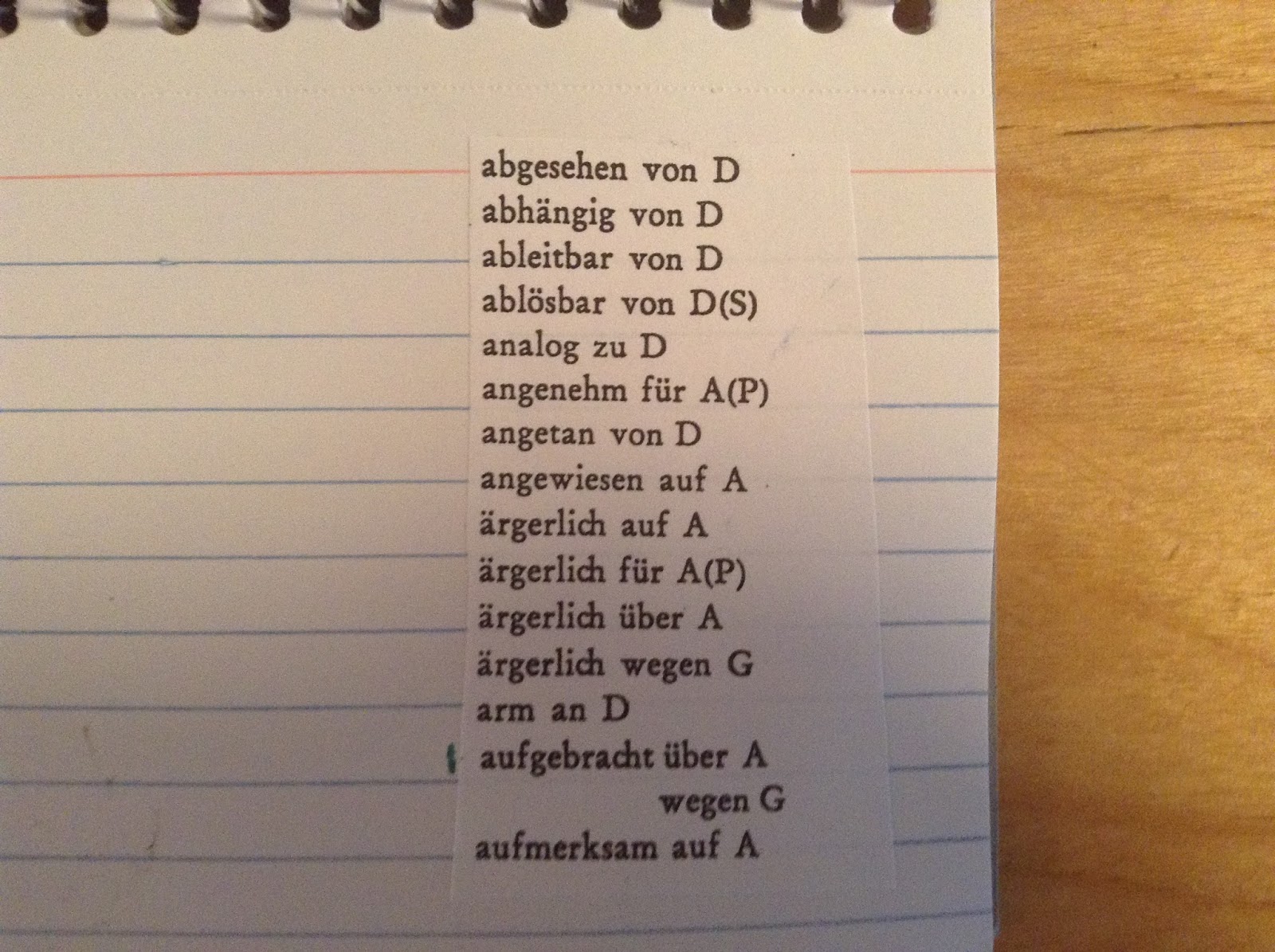
2) Preposition-adjective combinations
3) Idiomatic verb-preposition combinations
4) Idiomatic noun-verb-preposition combinations.
Then in a few cut-and-paste sessions ...
... I put together three new index-card notebooks. The first ...
... combines the first two lists, idiomatic prepositional phrases:
and idiomatic preposition-adjective pairs:
The second notebook:
Contains this sort of thing:
And the third notebook:
These puppies:
Obviously this is advanced and bookish language (especially the noun-verb-preposition combos), not the kind of thing one thinks of as conversational. And indeed, it's hard to imagine imagine ever trying to work an expression like etwas in Abrede stellen or eine Anfrage richten an into conversation with J!
Still, a large number of these expressions do occur in our L2 reading and listening, especially in the non-fiction materials. Furthermore, my own German, which is conditioned by literary and academic discourse, is simply rather bookish, so that is one of the linguistic registers J is going to get from me and I make no apologies for it. Lastly, the next notebook I'm planning will be a counterbalance to the elevated style: slang and "youthspeak." Already J says things like Verkrümele dich! and Verpinkele dich! when he wants me to stop bothering him! ;)
It's all about having multiple linguistic registers at one's command.
*Here's the most recent edition.
Recently Jamie has started playing Minecraft himself, and has become quite addicted to it. We limit his gameplay of course, but on the whole I think it is a very engaging, mentally challenging, and creative activity, as are many video games. He's already built an amazing little gameworld and loves to show us around it.
Which is where L2 comes in. If I just sit down next to him as he plays and ask him what is going on, he will talk and talk. It's a kind of storytelling in which he is the main character.
His experience watching German Minecraft videos for four months has given him an extensive vocabulary, and his language of physical and locative description is getting very smooth and idiomatic.
This morning I had my language notebooks with me and, in my questions and comments, wove in a number of specific words and expressions I wanted to work on.
Also, it was fun.
Today we took one of our standard walks, over to the local hospital, where there are large service areas and waiting rooms to explore, as well as elevators and winding staircases. However, today we had a mission. J wanted to show the hospital our resident physician, Dr. Brausefrosch.
Some of you may recall Dr. Brausefrosch from Janosch:
He retired from that clinic a couple of years ago and came to live with us. Anyway, we took him over to the local hospital. Since Dr. Brausefrosch is a Very Distinguished Person, we use the formal address (Sie, Siezen) with him. In addition to that, I had my little notebook with and we practiced the following:
Previous material:
jemanden einholen
dicht auf den Fersen
vom Fleck kommen
Was hat das für einen Zweck?
Woran liegt es denn, dass
ein Mittel gegen etwas
sonderbar
es kommt darauf an, ob
das hängt davon ab, wie
das hängt von ___ ab
die Kräfte gehen einem zu Ende
von mir aus können wir
gewohnt sein + Gen.
gewöhnlich
wegputzen
dann und wann
wie am Schnürchen klappen
uns gegenüber (on the street)
nicht lange fackeln
ganz danach aussehen, als würde es
Ich weiß nicht, worauf du hinauswillst.
Was hältst du von _____?
jemanden gut leiden können
New material:
jemanden abhängen
darstellen / dargestellt werden (in works of art)
öffentlich
ganz an Dir liegen
einen schlechten Ruf haben
für etwas zuständig
von Grund auf
von Natur aus
neulich
Was soll das eigentlich?
auf jemanden Rücksicht nehmen
rücksichtsvoll
verkehrt
Vorurteile hegen
Then we came home, and Dr. Brausefrosch and J took care of some sick animals.
I made sure to get a short walk & talk in before J's school this morning because I wanted to work on some material from the bullying audiobook.
Practice with previous material
absichtlich
sich versöhnen
sich vertragen
jemanden ausstoßen
New material
jemanden ausgrenzen
sich von anderen ausgegrenzt fühlen
Today J and I drove to Hard Labor Creek State Park to see if we could see any snakes. Zischli and Wischli came along:
As well as Schnubi (around J's neck):
Unfortunately we didn't see any snakes, but I had my notebook and we practiced a lot of words and expressions.
Practice with previous material:
reichlich weit
verschnaufen
dicht auf den Fersen
Woran liegt es denn, dass
wohl oder übel
Das haben wir nun davon.
Es ist nun einmal so.
Man kann nichts dafür.
Du kannst dich darauf verlassen.
Nachdem die sechs Wochen um sind,
nicht in Frage kommen
auf gar keinen Fall
sich an etwas gewöhnen
wild auf etwas sein
sich trauen
jemandem etwas anvertrauen
New material:
Mumpitz
für den Fall, dass
in den Sinn kommen
die entgegengesetzte Richtung
schalten (= verstehen)
schonen (die Umwelt)
sich abstützen
versessen auf etwas sein
wittern
Es gibt kein Mittel dagegen.
Es liegt daran, dass
Was hältst du von ________?
Worauf willst du hinaus?
Wie sollte man sich jemandem gegenüber verhalten,
der...
Lately J has been very vocal about his likes and dislikes, so we're going to work on some expressions around that.
etwas nicht leiden können
jemanden nicht leiden können
etwas gut leiden können
jemanden gut leiden können
Today J and I took a 1.5 hour walk at the Botanical gardens, splashing in the brook and looking for arrowheads.
Practice with previous material:
schädlich / unschädlich
verschnaufen
Woran liegt es, dass ...?
einem zu denken geben
sich trauen
Nichts wie weg!
einem gehen die Kräfte zu Ende
New material:
eh' schon
nix drin
(Das) spielt keine Rolle.
dann und wann
eine heiße Spur
nicht lange fackeln
eine vertrackte Sache
einen guthaben bei jemandem
jemandem etwas verklickern (= klarmachen)
durchdrehen
ausflippen
abregen
keinen Schimmer haben
tote Hose
losdüsen
nachlassen (Schmerz)
sich verausgaben
After a surfeit of usage in the last few days J has already started using idiom 1 independently, so it's time to move on. A scene in Sophiechen und der Riese provided me with the next one. The BFG is confiding his secrets to Sophie and asks her "if he can depend on her not to tell anybody else."
sich auf jemanden verlassen.
Today J used these conjunctions for the first time independently, pretty much right on schedule in terms of the number of reps I have recorded (I'm pretty sure I neglected to record two or three reps).
I'm renaming this excercise because it has very quickly become clear that one day will not suffice to work the expression in a really meaningful way. So now I will keep a particular idiom "in focus" until I feel we have explored it a sufficient syntactic and semantic depth.
With anvertrauen, for example, it takes awhile to generate enough conversation such as to cover the two basic usages, one involving a direct object (jemandem etwas anvertrauen, "to entrust/confide something to somebody") and one reflexive (sich jemandem anvertrauen, "to confide in somebody"). So far I have used the former with J but not yet the latter.
Plus it is necessary to exploit the different syntactical possibilities involving the seperable prefix.
1. Ich habe auch ein paar weitere Geheimnisse aus meiner Kindheit, die ich dir später anvertrauen werde.
2. Ich habe auch ein paar weitere Geheimnisse aus meiner Kindheit, die vertraue ich dir später an.
I did manage to use both of these this morning, but they bear a lot of repetition.
Update 4.4.15: J used this expression with me this morning, after two days of repeated usage by me in various contexts.
With "reading words of the week" and "vocabulary walks" working so well, I'll now try daily introducing a particular idiom into conversation.
jemandem etwas anvertrauen, "to confide something to somebody."
This morning on our way to school I said to J: "Darf ich dir etwas anvertrauen?", then proceeded to tell him about my special relationship with my best friend Peter and Peter's son Gabriel, my godson, who visited this past weekend. This is not new information for J, nor is it exactly the kind of thing one needs to say "in confidence," so the idiom usage was a little oblique. But close enough. This evening I'm going to work something like the following into our chat.
"Weißt du, du kannst mir alles anvertrauen. Wenn es je etwas gibt, worüber du reden willst, was aber vielleicht peinlich oder schmerzlich ist, das kannst du mir und der Mama immer anvertrauen, und wir besprechen die Sache und helfen dir dabei. Verstehst du?"
See the update on this post.
Today J and I took a two-hour-long chatty walk at a nearby park. I had my vocabulary notebook; we worked the following:
Practice with previous material:
schaden + Dat
genügen + Dat
Vorteile / Nachteile
einen / keinen Zweck haben
das Nachsehen haben
reichlich weit
sich täuschen
sich verschnaufen
sich gewöhnen an + Akk
Bescheid wissen
rumhocken
auf den ersten Blick
seine Kräfte übersteigen
jemandem gehen die Kräfte aus
Woran liegt es, dass ...
wohl oder übel
Das ist nun einmal so.
Das lässt sich nicht ändern.
New material:
Stubenhocker
und zwar
dem ist nicht so
jemanden für etwas halten
Was gäbe ich drum, wenn
Today J and I took an hour-long chatty walk in the neighborhood. I had my vocabulary notebook; we worked the following:
Practice with previous material:
sowohl als auch
sich auskennen
sich herausstellen
sich täuschen
sich seiner Sacher sicher sein
sich gewöhnen an + Akk
große Stücke auf jemanden halten
insgesamt
Bescheid wissen
in Frage kommen
mit jemandem ein Wörtchen zu reden haben
jemandem nicht hineinreden
jemandem etwas nachmachen
New material:
ablenken
auf den ersten Blick
alleine auf sich gestellt sein
reizen
reizbar
rumhocken




.JPG)


