It's been a year since I last did an "idiom in focus" post. They come up all the time, of course, but I want to start targeting them again.
Today in our daily conversation time at the start of the school day we discussed various things that faze, flap, and fluster us. J quickly had several examples to hand and used the idiom correctly right away.
One thing I noticed about J's narration skills is that he is very solid on the use of the pluperfect:
- Als die Freunde ein Versteck für die Nacht gefunden hatten, legten sie sich aufs Ohr.
- Nachdem die Freunde aufgewacht waren, flogen sie weiter.
- ... bis sie eine von den kleinen Sandsteinhäusern sahen, die Rätsel und Mätzel gebaut hatten.
Also, he picked up the idiom "sich aufs Ohr legen" somewhere along the way, since it's not one that I tend to use. He has used it twice in the story so far.
I've been "seeding" this construction for months in my conversation with J. Today was the first time I've heard him use it unprompted. We were talking about his teachers at school, and he said: "Je älter ich werde, desto strenger werden die Lehrer!"
Up until now, I've been using a single index-card notebook to record German words and expressions I want to work on with J. Although this is "systematic" to the extent that I strive for a certain number of repetitions, the material itself is not organized in any particular way; I just write down any word or expression I think it would be a good idea for J to know. I talk about this here.
This summer, I've decided to start organizing this material systematically. So I took out this book...*
.... and photocopied the four comprehensive lists of idiomatic expressions:
1) Prepositional phrases
2) Preposition-adjective combinations
3) Idiomatic verb-preposition combinations
4) Idiomatic noun-verb-preposition combinations.
Then in a few cut-and-paste sessions ...
... I put together three new index-card notebooks. The first ...
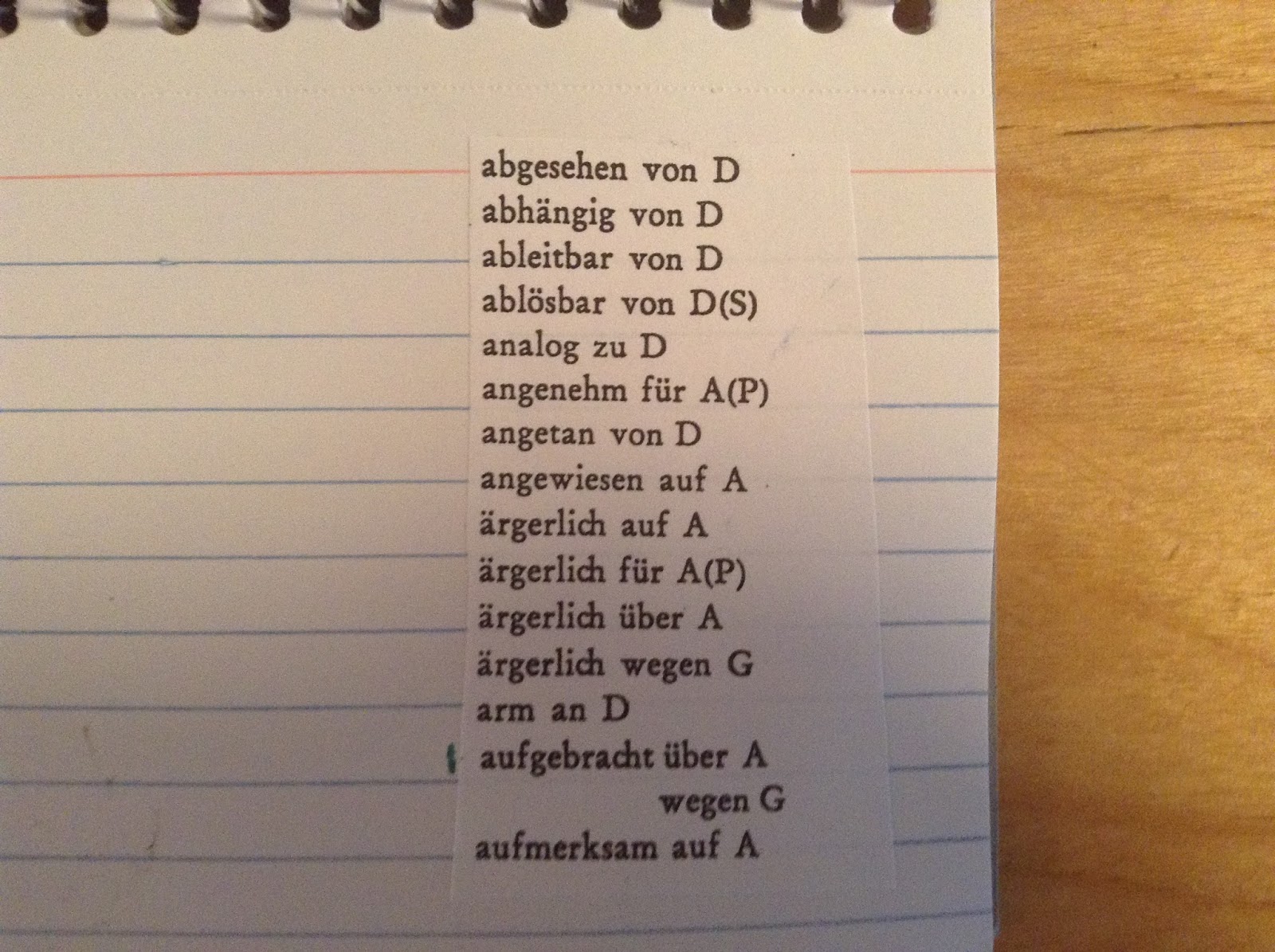
... combines the first two lists, idiomatic prepositional phrases:
and idiomatic preposition-adjective pairs:
The second notebook:
Contains this sort of thing:
And the third notebook:
These puppies:
Obviously this is advanced and bookish language (especially the noun-verb-preposition combos), not the kind of thing one thinks of as conversational. And indeed, it's hard to imagine imagine ever trying to work an expression like etwas in Abrede stellen or eine Anfrage richten an into conversation with J!
Still, a large number of these expressions do occur in our L2 reading and listening, especially in the non-fiction materials. Furthermore, my own German, which is conditioned by literary and academic discourse, is simply rather bookish, so that is one of the linguistic registers J is going to get from me and I make no apologies for it. Lastly, the next notebook I'm planning will be a counterbalance to the elevated style: slang and "youthspeak." Already J says things like Verkrümele dich! and Verpinkele dich! when he wants me to stop bothering him! ;)
It's all about having multiple linguistic registers at one's command.
*Here's the most recent edition.
All of a sudden J has started to use this idiom a lot. In terms of rep training, more or less right on schedule.
Lately J has been very vocal about his likes and dislikes, so we're going to work on some expressions around that.
etwas nicht leiden können
jemanden nicht leiden können
etwas gut leiden können
jemanden gut leiden können
This idiom is usually translated "to dare to do something," but a better translation is something like "to muster the confidence to do something." Daring tends to be an outward pressure; sich trauen is more about one's inner state.
Like with idiom 1, I've been deploying it by telling J various things I didn't and did have the confidence to do as a boy.
Today was the first time I've heard this expression spontaneously from J. I've been working on it consciously for a few weeks, though at the moment I can't find my little notebook to see how many times I've marked it down. I'll update when I find it.
After a surfeit of usage in the last few days J has already started using idiom 1 independently, so it's time to move on. A scene in Sophiechen und der Riese provided me with the next one. The BFG is confiding his secrets to Sophie and asks her "if he can depend on her not to tell anybody else."
sich auf jemanden verlassen.
I'm renaming this excercise because it has very quickly become clear that one day will not suffice to work the expression in a really meaningful way. So now I will keep a particular idiom "in focus" until I feel we have explored it a sufficient syntactic and semantic depth.
With anvertrauen, for example, it takes awhile to generate enough conversation such as to cover the two basic usages, one involving a direct object (jemandem etwas anvertrauen, "to entrust/confide something to somebody") and one reflexive (sich jemandem anvertrauen, "to confide in somebody"). So far I have used the former with J but not yet the latter.
Plus it is necessary to exploit the different syntactical possibilities involving the seperable prefix.
1. Ich habe auch ein paar weitere Geheimnisse aus meiner Kindheit, die ich dir später anvertrauen werde.
2. Ich habe auch ein paar weitere Geheimnisse aus meiner Kindheit, die vertraue ich dir später an.
I did manage to use both of these this morning, but they bear a lot of repetition.
Update 4.4.15: J used this expression with me this morning, after two days of repeated usage by me in various contexts.
With "reading words of the week" and "vocabulary walks" working so well, I'll now try daily introducing a particular idiom into conversation.
jemandem etwas anvertrauen, "to confide something to somebody."
This morning on our way to school I said to J: "Darf ich dir etwas anvertrauen?", then proceeded to tell him about my special relationship with my best friend Peter and Peter's son Gabriel, my godson, who visited this past weekend. This is not new information for J, nor is it exactly the kind of thing one needs to say "in confidence," so the idiom usage was a little oblique. But close enough. This evening I'm going to work something like the following into our chat.
"Weißt du, du kannst mir alles anvertrauen. Wenn es je etwas gibt, worüber du reden willst, was aber vielleicht peinlich oder schmerzlich ist, das kannst du mir und der Mama immer anvertrauen, und wir besprechen die Sache und helfen dir dabei. Verstehst du?"
See the update on this post.