Piggy pedagogy

Piggy pedagogy
Showing posts with label songs and music. Show all posts

Friday, January 1, 2016

Media update 282 (last of 2015)

Reading: Cornelia Funke, Drachenreiter, 42-153/448. Listening: Die 30 schönsten Kinderlieder, Teil 1 (65 min.); Die 30 schönsten Kinderlieder, Teil 2 (64 min.); Paul Maar, Jaguar und Neinguar. Gedichte (48 min.); Gerd Köster, Die fabelhafte Welt der Tiere: Fische und Vögel, 0-49:00; Ulrich Janßen, Ulla Steuernagel, Die Kinder-Uni, "Warum lachen wir über Witze?" (0-27:00); A. A. Milne, Pu der Bär, (about 20 min.); Pinkus Tulim, Jo Raketen-Po: Ein Pupsbuch (160 min.); George R. R. Martin, Das Lied der Eisdrache (60 min.); Michael Ende, Jim Knopf und Lukas der Lokomotivführer, 0-3.53. 

All of the above took place on a roadtrip, that's the reason for all the listening. 


 The Kinder-Uni nonfiction series is similar to the Albert E. audiobooks we have been listening to for the past two years, but it is a good bit more advanced in terms of both the language and the subject matter. It's also not quite as good in terms of the presentation. Albert E. audiobooks have a nice balance between presentation of the topical knowledge and a little story that exemplifies the material in the lives of children characters. So far (half an hour in), the Kinder-Uni is just straight-up knowledge-presentation, which is a little boring. We'll see. The topics themselves are interesting and reflective. 


The George Martin story—wow, just brilliant. And I like that the main character is a little girl. I think J found it a little grim, and it does have a sad ending, but it's the kind of ending that stays with you. 


The Tulim story is pretty funny. It's very much in the spirit of Roald Dahl in terms of valorization of lower bodily functions, the utter contemptibility of parental and authority figures, and the nastiness of spoiled children. I would say, however, that it goes on just a bit too long. The frobscottle episode in the BFG was only one episode in a complex story; here, farting does all the work. J found it funny for about an hour, then I think he started to tune out. 


The Jim Knopf book is our first encounter with Michael Ende, whom I've been waiting a long time to get to. This is a wonderful, endlessly inventive story and J loves it, wanting to hear many sections several times over and interrupting to give observations and commentary. 

I was a bit worried at first that the main character, being a little black boy, would be "essentialized" in a racial way, but apart (so far) from one use of the word Neger (see here for previous commentary), and the fact that black skin is associated with dirt and soot (in the figure of the locomotive driver), that has not been the case. I did pause the story at Neger—J asked what the word meant—and explain about it at some length. 

The book is noted for it's coded critique of Nazism; that's in the later sections, in the dragon city, which we have not yet gotten to. 

2015
Total audio: 80.33 hours
Total video: 95.26 hours
Age 6.02.31

Friday, June 12, 2015

Puppets and piano practice 7

J performed in his first piano recital in early May. He played "City Sounds" by Helen Marlais, then together we played "Alles neu macht der Mai" as a duet.  


After weeks of practice with these two short pieces, they were very polished, so J played them very well and enjoyed himself immensely, mostly because he knew he played them well and the audience responded accordingly. The first thing he said after he sat down was "When are we going to do this again?" 

Ever since the recital, his attitude toward practicing at home has been transformed. He now freely sits down more at the piano, practices on his own initiative, lets me sit next to him and help him, and enjoys playing his pieces as duets with me.

So, even though I've felt guilty and questioned myself on the many occasions when J has burst into tears at the keyboard, I do feel vindicated in pushing him rather hard over the last months. With music, as with many things, there's a positive-feedback loop: If one doesn't practice, then the first recitals can be unpleasant or even traumatic, leading one to want to practice even less, leading to ever worse recital experiences. If one practices, one plays well, enjoys oneself, and wants to practice more. For this reason, I felt it was crucial that his first recital experience be positive. 

One upshot of this is that Friedel and Thusnelda don't have to intervene anymore in the practice sessions and reprimand me for my strictness. Or that's how it was for awhile, anyway. Recently there have been a couple of minor rough patches, and J has summoned them once again to mediate. 

It's more lighthearted now though. J's recent thing is to have Thusnelda help him with the practice and dance along to the music while Friedel holds my mouth shut. 


Saturday, May 2, 2015

"Alles neu macht der Mai," 2

Happy May greetings from Jamie and me!   


Alles neu macht der Mai        

Alles neu macht der Mai,
macht die Seele frisch und frei.
Lasst das Haus, kommt hinaus!
Windet einen Strauss!
Rings erglänzet Sonnenschein,
duftend prangen Flur und Hain:

Vogelsang, Hörnerklang tönt den Wald entlang.

Everything is new in May

Everything is new in May,
The soul is refreshed and free.
Leave the house, come outside!
Tie a fresh bouquet!
The sun is shining all around,
Meadows and groves are fragrant:
Birdsong, horncalls
Sound throughout the forest.

Monday, April 6, 2015

Media today 108: Friendship; German folk songs (Volkslieder)

Listening: Roald Dahl, Sophiechen und der Riese, 0-50:00; Ich weiß was, "Albert E. erklärt Freundschaft," 0-15:00; Kinderlieder deutsch. Frühlingslieder Video mix (24 min.); songs by Fredrik Vahle (60 min.) 

Viewing: Benjamin Blümchen, Benjamin Blümchen bei den Eskimos (26 min.), Die kleinen Schildkröten (26 min.); Benjamin Blümchen findet einen Schatz (26 min.); Let's Play Kung Fu Panda, Episode 2 (20:00).


J has been asking to listen to the Dahl story again. The last time was just over four months ago. Whereas before he was just getting attuned to the funny grammar and syntax mistakes the BFG makes, this time he is very aware of a lot of them and laughs at them independently of me. We had a long conversation about Sophie's and BFG's conversation about whether flowers and trees and other plants have feelings like animals. J said he didn't think they did, but was open to the possibility that they do.


When my wife and I ask J questions about his friends at school, he rarely responds with much information. "Yes" and "no "and maybe short sentence or two. Today, when I started playing the friendship audiobook, wow, the floodgates opened, and with practically every scene J was interrupting and describing at length and in great detail and nuance the—similar or contrasting—dynamics between himself and his closest friends at school. I learned more about these friends during this half an hour than during this whole past year. 


One very funny thing he said in this conversation: "Weißt du Papa, warum ich und T und D und M so gute Freunde sind? Zwei Bedeutungen: Erstens, weil wir alle Quasselstrippen sind, zweitens, weil wir alle ganz albern sind." 

The children's songs (Kinderlieder) are traditional German songs about spring. We've been listening to this particular collection for exactly a year. The arrangements are pretty saccharine, but the sound quality is excellent, the lyrics are very clearly sung, and they also scroll accross the screen with the music. As he plays, J has been stopping to watch and read them a good bit.


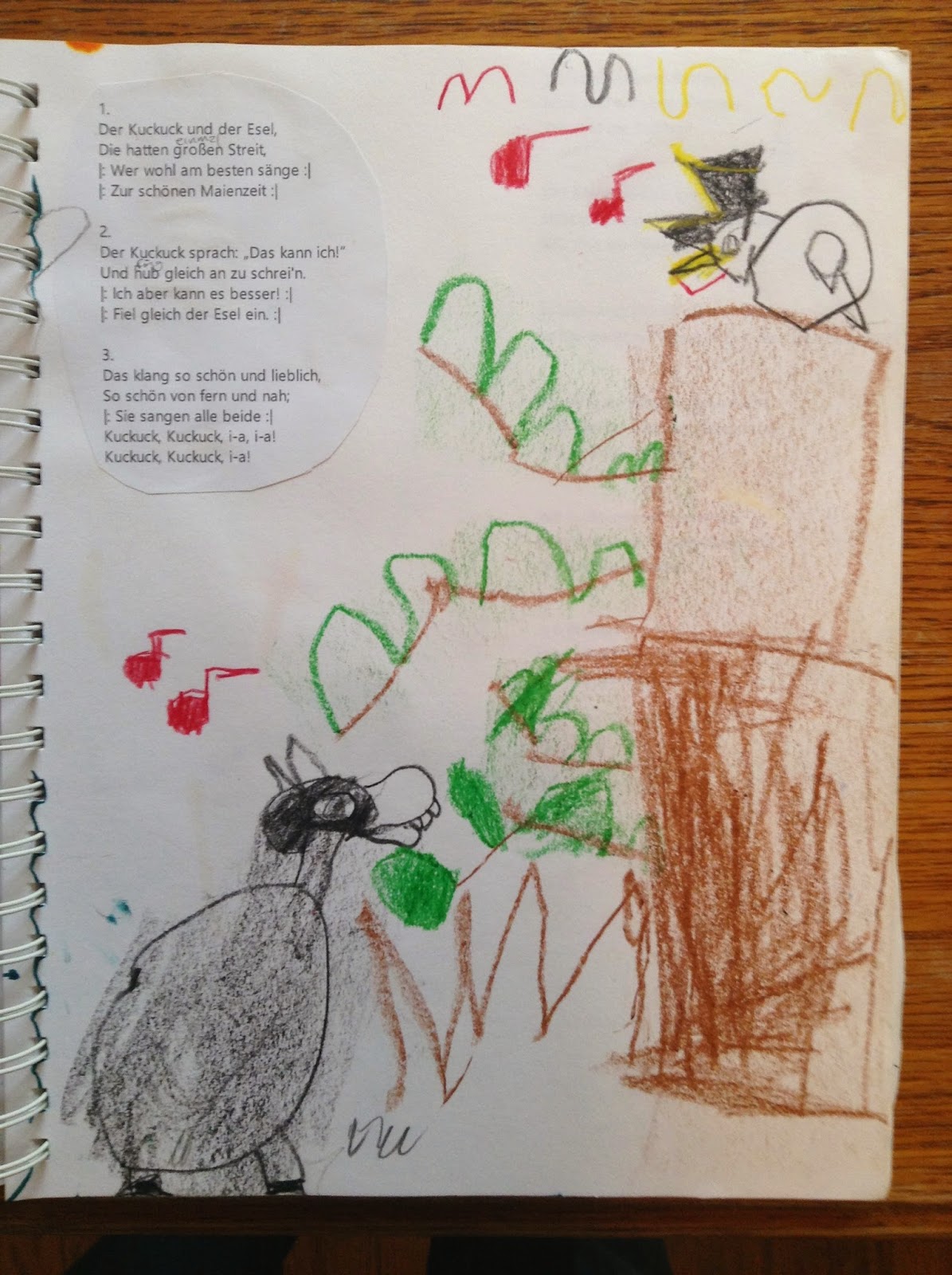
This year I let the music play in the background as we do things around the house. Last year I was much more focused. I printed out the words to many of the songs, pasted them in J's art book, and together we made matching drawings and talked about the songs. Here are several of those:


Occasionally we have made our own lyrics to the melodies. Here's one of several stanzas we have written after "Alle meine Entchen":


Since J is a skunk nut, using the scenario and the melody to "Der Kuckuck und der Esel," we composed a poem about a stink battle between a skunk and an Iltis, a related species that also uses scent glands as a means of defense. 


The lyrics are:


Das Stinktier und der Iltis,

die hatten einmal Streit:
Wer wohl am schlimmsten stänke,
zur schönen Maienzeit [oder Stinkezeit],
zur schönen Maienzeit.

Das Stinktier sagt: "Das kann ich!"

Und fing zu stinken an.
"Das aber kann ich besser,
das aber kann ich besser!",
fiel gleich der Iltis ein,
fiel gleich der Iltis ein.

Das stank so schlimm und furchtbar,

so schlimm von fern und nah.
Die stanken alle beide,
die stanken alle beide,
Zzzt, zzzt, zzzt, zzzt [Spritzgeräusche], plttt, plttt [Pupsgeräusche]!
Zzzt, zzzt, zzzt, zzzt, plttt, plttt!

Total audio 2015: 21:30
Total video 2015: 41.45
Age 5.6.6

Saturday, January 24, 2015

Puppets and piano practice 4: little breakthroughs

While Friedel's and Thusnelda's intervention has definitely helped, piano practice has continued to be a mixed bag, and sometimes the puppet preliminaries end up taking so much time and being so much of a focus that the piano loses out. 


The piggies have to get past J before they can play the piano.

It continues to be difficult for me to stay calm and patient, and at this point J feels that even Thusnelda is sometimes "too strict." My wife has suggested that J can now start practicing on his own, and yesterday under her aegis he actually did sit down and, for a few minutes, practice with concentration. She told me that as he finished, he looked up and beamed!

And this morning there was another little breakthrough. After noodling about on the keys a little, he got a piece of paper, announced he was going to write a song, and started drawing notes. 


"What is the song about?" I asked, since I heard him mumbling words. "About a snake, a sidewinder," he replied. He had a first verse in mind already: Die kleine Schlange schlängelt sich, but was hung up on the second part. I suggested du-u-urch die Wüste. He liked that. He finished the melody, hummed it to himself with the words,


Took the song to the piano and played through it, 


Then asked the piggies come and listen. We couldn't find Friedel, so he played the song for Thusnelda.


Here's the finished composition (he changed sich schlängeln to sich winden):


Die kleine Schlange windet sich / du-u-urch die Wüste

On our shopping trip afterwards he was already working on a second song. He proposed Die kleine Schlange frisst die Maus, die schluckt sie ... and then got hung up. I proposed die schluckt sie ganz herunter, which he liked. He wrote the music when he got home.


Saturday, January 3, 2015

Puppets and piano practice, part 3

Today when doing his key-coloring in preparation for piano practice, J divided each key into three spaces, one for himself, one for Friedel and one for Thusnelda.


Monday, December 15, 2014

"Alles neu macht der Mai"

Lately J's been constantly humming and singing the German Volkslied "Alles neu macht der Mai," which he (and I) first learned in connection with Otfried Preußler's Der Räuber Hotzenplotz. Here he is singing it in his nonsense language:


Puppets and piano practice, part 2

Piano practice has been going generally very well ever since Friedel and Thusnelda took over. Each time, I try to think up new games and play strategies as a fun introduction to the lesson. 

One that we've been doing the last couple of times involves Friedel and Thusnelda having to get past J to the piano, whereby he beats them off with martial arts moves and the help of other animals. 


This worked extremely well today—at first. J actually requested *extra piano practice* so that he could play the game more times. But then something unfortunate happened. When one of the piggies finally did succeed in getting past the defense, J became quite angry. 

Now, according to my puppetry philosophy, which I explain in my essay, all the puppets have their own personalities and dignity. So J doesn't get to have it all his way all the time. This was one of those times. The piggies felt that they had gotten past J's defenses quite fairly, and that it is unfair of J to expect to win every time. However, right now this has only made J angrier, and he told us he never wants to play the game again, and at the moment I'm writing this he is off muttering to himself in another room—in German, by the way! 

So it's an end to piano practice today. But I'm hoping that in the bigger picture the piano practice, the puppetry, and J's social development in general is better served by enforcing these kinds of rules. 

Update: half an hour later J is calm. He explained to Friedel and Thusnelda that their move—one piggy catapulting the other over the Christmas tree—was not good because they could have knocked off and broken an ornament. They agreed and said they would not do that again. In turn, they asked him if it was ok if they won once in awhile without J getting angry. He agreed. 

Wednesday, December 3, 2014

Puppetry today 2

The two hours this morning before J's school were a whirl of puppetry. First, he wanted a reprise of the Tannenbaum game from last night. This time we got through all three stanzas. I even managed to work in a bit of literary criticism by having the piggies ask what the last stanza means:

O Tannenbaum, O Tannenbaum,

Dein Kleid will mich was lehren:
Die Hoffnung und Beständigkeit
Gibt Mut und Kraft zu jeder Zeit!
O Tannenbaum, O Tannenbaum,
Dein Kleid will mich was lehren.

I told them it's about how the tree means two things at the same time. First and most importantly, the tree just means itself, but secondly, it's also a symbol for something else which is a little harder to explain. Then I elucidated a bit what the connection is between the evergreen needles and hope and constancy. 


The puppets are great way of introducing such things, by the way. J himself, of course, is not at the point of asking such questions himself. Nor is he much interested in hearing lectures from me out of the blue. But he pays very close attention when the puppets ask me questions. We have been through some version of the above scenario probably some half-dozen times in the past year, and by now J will volunteer things like "Das ist ein Symbol für ________" and "Das ist ein Zeichen von _________". 


After this J wanted to do some drawing and coloring. He opened his coloring book to some peafowl, which he is very interested in. So he went and got Percy, our resident peacock (also from Folksmanis), and the three of us sat around the table while J colored, I read out loud about peafowl, and Percy commented.  


All the while J was humming O Tannenbaum, so then, as we often do with songs, we tried to come up with new lyrics. Here is what we worked out with Percy, then with Ulli (mouse) and Franziska (gliding squirrel). Lines and words J came up with by himself are marked in green. 


O Vogelpfau, O Vogelpfau,

wie schön sind deine Federn!
Sie leuchten durch das ganze Jahr,
besonders wenn es draußen klar,
O Vogelpfau, O Vogelpfau,
wie schön sind deine Federn.

O Gleithörnchen, O Gleithörnchen,

Du bist ein guter Gleiter!
Du gleitest schön von Baum zu Baum,
Du gleitest über Schaum und Pflaum.
O Gleithörnchen, O Gleithörnchen,
Du bist ein guter Gleiter!

(Scansion of the first line doesn't quite work, but we make it work.)


O Mäuseli, O Mäuseli,

Du bist ein guter Renner!
Du huschst im ganzen Haus herum ...

Then something about cheese as we arrived at school... 

Tuesday, December 2, 2014

O Tannenbaum, O Tannenbaum, wie treu sind deine ...

This evening as we were decorating the Christmas tree, Friedel and Thusnelda broke into O Tannenbaum. 


When they sang "Wie treu sind deine Blätter," J corrected them and said that Christmas trees don't have Blätter (leaves), but rather Nadeln (needles) and that it should be "Wie treu sind deine Nadeln." The piggies insisted that the words were right and sang it in his face, whereupon he squished their mouths shut. There followed about 10 minutes of horseplay where the piggies sang things like O Jamiebaum, O Jamiebaum, wie grün sind deine Ohren whenever he let their mouths out of his grip. He finally had to sit on them.

Thusnelda told J that people first started decorating Christmas trees in Germany a long time ago. She also told him that the custom was actually started by wild pigs, not humans. According to her, they would use their tusks to hook the ornaments and hang them up on the trees. "Das ist völliger Quatsch" (complete nonsense) J said.


I also read to J a bit about Christmas trees on Wikipedia, including a few sentences each from the Allemanic and Bavarian entries. I told him these were different kinds of German people spoke in certain areas of Germany and Switzerland. When I asked him if he could understand any of it, he said no.


Saturday, November 22, 2014

Puppets and piano practice, part 1

I freely admit, I bring a lot of unhealthy baggage to my son's piano practice. The puppets help me with that. 


I am a failed classical musician, and I lay heavy blame on my parents. As a child, whenever I was in a room with a piano (practically every week at my cousins' house), I would sit and tap out little pieces and compositions. My folks never got a clue. Later, at 13, when I expressed interest in the guitar, they bought me a K-Mart special with string action so high it was unplayable. That killed three more years, after which I finally took it into my own hands to get a decent instrument and some instruction—ad hoc via my cousin, not actual lessons. 


But 16 is simply too late a beginning for someone with performance ambitions in the world of classical music, as would become painfully clear to me when I studied classical guitar in college.


One unhealthy way this baggage has manifested itself is that I was overzealous in redressing it in J's case, such that we probably started his piano lessons too early (at 4.8). We should have waited until he was 6 or 7. But the biggest problem is that I have a very hard time being patient during practice. This sets up a nasty feedback loop: I get impatient, J feels bad and wants to stop playing, which makes me more impatient, etc. I really don't feel I have this problem in any other area—just with music. And self-awareness doesn't seem to help much, at least when it's just J and me at the piano. 


This is where the puppets come in.  


I have always used them in encouraging J's interest in music, for example by providing another enthusiastic audience:


But  a couple of weeks ago, when the piano experience became so negative that we were talking about stopping the lessons, I realized that the puppets could do much more to help. They could conduct the practice sessions with J all on their own. Here, my wife was the pioneer. One day when I wasn't around, she had one of J's favorite stuffed kitties lead a practice, and it went great. She says she was just employing my methods, but for some reason this had just not occurred to me.  

So I've turned it all over to the puppets now. They suggest the practice session, they prep the pieces, they offer corrections and comments, and they sing along. Everything is more relaxed, a little slower, and, of course, there is lots of silliness. But there is also progress. J listens to the puppets far better than to me, and the puppet personalities are so established that I am able to be more patient when I am in character than when I am just myself. Friedel, for example, is the essence of porcine chill; it is unthinkable and unfeelable to get impatient with J while I am doing Friedel.


Or almost unfeelable. And here is the real rub. Now, when I do find myself getting impatient, I simply have the puppets turn to me and slap me down, like this:


"Herr Sager, halten Sie bitte den Schnabel! Sie haben gesagt, Sie wollten sich nicht mehr einmischen. Das haben Sie versprochen! Der Kleine meint, Sie sind zu streng und zu ungeduldig. Er mag es, wenn wir mit ihm üben, mit Ihnen mag er's halt nicht. Wir können's besser machen. Wenn Sie geduldig sein können, dann dürfen Sie ab und zu was sagen, aber bitte nicht zu viel!"


("Herr Sager, please shut your trap! You said you would not interfere. You promised! J said that you are too strict and too impatient. He likes practicing with us, he doesn't like practicing with you. We can do it better! If you can be patient, you can say things sometimes, but please not too much!")

J loves it when the puppets lay into me, and this has restored real enjoyment to the practice sessions. Castigating myself in this way
—sometimes with real vehemence—is a tangible psychological release, helping me work through the bugbears and develop more real patience in this area.

Sunday, November 16, 2014

Saint Martin's Day

Yesterday we celebrated Saint Martin's Day (Nov. 11) with the Germanophone kiddies at the apartment complex of one of our group.


After some twilight tennis, playground horseplay, and dinner, we fired up the homemade lanterns, I strapped on my guitar, and the twelve of us (four adults and eight kids) put on a very respectable little Laternenlaufen for the neighborhood. We sang "Ich geh mit meiner Laterne" and "Sankt Martin ritt durch Schnee und Wind" numerous times, and in numerous keys. We got a lot of funny looks from passing drivers! Then we all went back to the house and had tasty homemade Weckmänner.


J was excited for days beforehand. In preparation we watched and talked about this lovely video from Sendung mit der Maus: